As we usher in the Fall semester, we have much more to celebrate than the changing weather and the promise of a new academic year. This season marks a monumental milestone: the 50th Anniversary of the completion of the magnificent CSUN University Library building in October 1973, originally known as the Oviatt Library. For half a century, our Library has served as the intellectual hub of our campus, a sanctuary of learning, and a facilitator for community engagement. This is not merely a testament to longevity; it's an affirmation of the vital role the CSUN Library has played in shaping minds, nurturing scholars, and enriching the broader community.
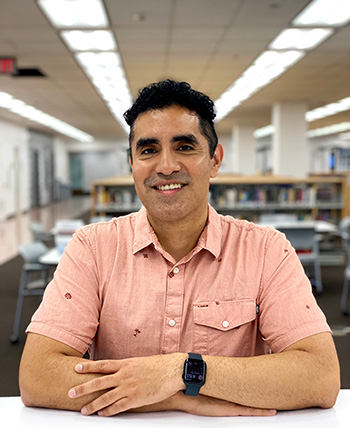
CSUN University Library Dean Mark Stover
Over the past 50 years, the CSUN University Library has experienced extraordinary growth. From its humble beginnings, equipped with a modest collection of books and periodicals, we have grown into a state-of-the-art facility with extensive digital resources, cutting-edge technologies, highly skilled librarians and support staff, and dynamic, multifunctional spaces. We are extremely proud of the collections and spaces that set us apart from other academic libraries, including the Gohstand Leisure Reading Room, the Teacher Curriculum Center, the Creative Maker Space, the Tom & Ethel Bradley Center Archives, and our extensive Map Collection, just to name a few. We have also forged partnerships and shared space agreements with other entities on campus, such as the Learning Resource Center, the University Corporation, and the Division of Information Technology. This transformation over the years reflects our unwavering commitment to academic excellence and innovation. Whether through the millions of online resources that are accessed each year, or the plethora of unique archival collections made up of hundreds of thousands of primary source documents, or the multitude of workshops on information literacy our librarians teach annually, we strive to offer the tools and knowledge base required for student success in an ever-changing world.
But a library is more than just a collection of books, journals and databases; it's a living, breathing entity that evolves with its community. The CSUN University Library is – and always has been -- a nexus for intellectual and cultural activities, not only for students but also for faculty, staff, local residents, and visiting scholars. Through diverse community programs, partnerships, and outreach initiatives, we have opened our doors—and our resources—to enrich the lives of all who seek knowledge.
As I have emphasized many times in the past, change is a constant in libraries. The British philosopher Alan Watts once said that “the only way to make sense out of change is to plunge into it, move with it, and join the dance," and that is a good way to describe the past half-century of the CSUN University Library. The many Library faculty and staff who have served at CSUN over the past decades have largely embraced this perspective and have enthusiastically “joined the dance.” That positive outlook on change has enabled our Library to move forward with innovation, boldness, and consistent contributions to student success.
As we celebrate this impressive milestone, we are not just looking back with pride; we're looking forward with fervor and ambition. The next 50 years hold limitless potential for innovation, community engagement, and the continued advancement of knowledge. The landscape of information may change, but our mission to serve as a cornerstone for learning and discovery remains steadfast.
I want to extend my deepest gratitude to each and every member of our community—students, faculty, staff, and visitors alike—for your continual support of the Library. The legacy of the CSUN University Library is not just half a century of books and buildings, but also of minds expanded and dreams fulfilled. Here's to celebrating our golden anniversary and to the countless opportunities that lie ahead!
He is more than a friendly, familiar face on the front lines of the University Library, but also a charismatic leader with a passion for training and developing student employees to provide memorable customer service. As a champion of the Library, Gabriel Castañeda has dedicated twenty years to the intellectual heart of the campus, starting as a student assistant to becoming a pivotal staff member as the Guest Services Lead.
Get to know Gabriel, an inspiring mentor and perpetual student of life.
Where it all started
Gabriel is an L.A. native from a bustling neighborhood near USC. He began working in the Library in 2003 as a student assistant in Guest Services. While he originally set his sights on becoming a comic book artist, Gabriel graduated from CSUN in 2009 with a Bachelor of Arts in English, Creative Writing. It’s no surprise that writing poetry and songs are among his hobbies today. While he started out as a very shy guy, the connections Gabriel made in the Library as a student were akin to a fraternity - becoming the catalyst for social growth and confidence. It was Gabriel’s favorite author, Neil Strauss, who introduced him to the concept that social skills can be learned, spawning a new perspective on human interactions.
Influence and Inspiration
Gabriel shared that his greatest inspiration working in Guest Services is the students. Not only do they keep him young, but they make him happy. The lifelong connections Gabriel has fostered with students on the team are a testament to his positive leadership style and supportive nature. As an aspiring stoic, Gabriel delves into practical philosophies with a deep appreciation for what’s most important in life. He is a firm believer in taking advantage of diverse learning opportunities and realizing his full potential. This personal growth mission includes taking a variety of courses at CSUN (currently studying Japanese), along with creative outlets like hip hop dance, jazz-funk, and singing lessons. Insightful advice Gabriel offers to students is, “Work on social skills. This isn’t something you learn in college.”
The Evolving Library
Of the many Library changes Gabriel has witnessed over the last twenty years, the most notable shift was in the culture. He appreciates the employee-centric and more accommodating environment under the current leadership team. “The administration really takes employees into account,” he shared. With the addition of friendly patron policies and open collaborative study spaces, the understanding of students’ needs is palpable. In his time as a commuter student, Gabriel was a regular in the Library with his CSUN boxing gear in tow, plus his other school supplies and meals. Knowing firsthand the challenges of education on the go, Gabriel is a fierce advocate for accommodating the needs of students. He also believes the Freudian Sip café was a great move, noting “Food and coffee are just as much of a resource as the books.”
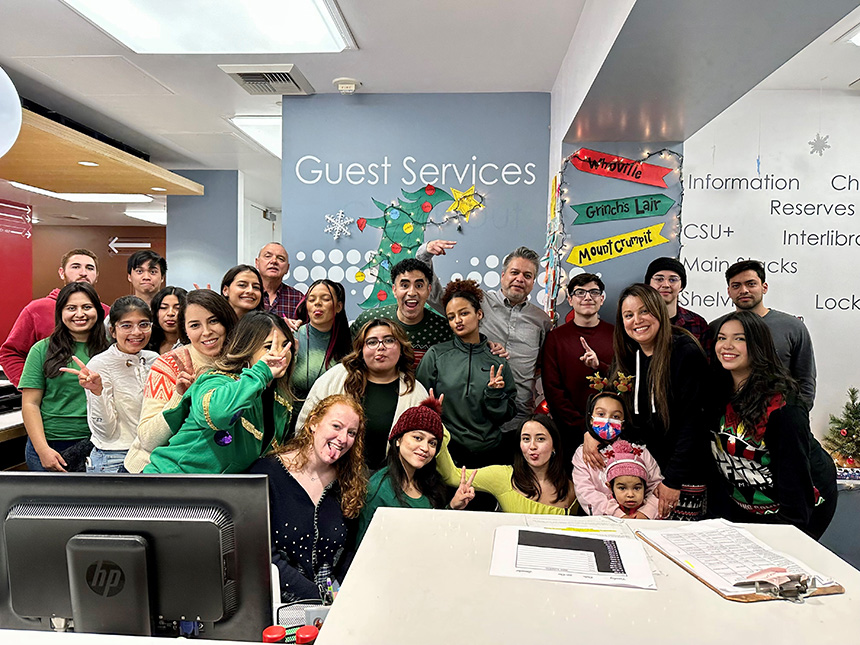
Group photo of Guest Services during the holidays.
Points of Pride
Gabriel is most proud of his growth as a leader, and as a person. While his identical twin brother was pursuing his Management degree at CSUN, Gabriel was intrigued by this subject matter. He began studying his brother’s textbooks and embracing leadership and customer service fundamentals, which have shaped his career and the work environment he’s created. With a firm belief that customer service is an experience, Gabriel developed an official Code of Conduct for student employees in Guest Services. The department’s mission statement, “To create an exceptional customer service experience by providing the first and last words” stems from two key concepts: 1) customer service is more than just checking books in and out, and 2) friendly greetings are the cornerstone of customer service.
Behind the scenes, Gabriel has fostered an open line of communication with students on the team, building trust, empathy, and loyalty. Celebrating students’ successes, ideas, and milestones is also an important part of the equation in cultivating joy and satisfaction in the workplace.
We in the Library are very thankful and proud of Gabriel’s positive contributions to Guest Services and his supportive role in student employee development.
The University Library was honored and overjoyed to present thirty awards to distinguished student employees at the 8th Annual University Library Student Employee Scholarship Reception in March 2023. As one of the largest employers of student assistants on campus, the Library takes great pride in fostering valuable student work experience and creating a supportive learning environment. One of the exciting benefits students love about working here is the opportunity to earn a scholarship – and sometimes, more than one!
Take a moment with us to appreciate the many dedicated donors and their unique scholarships. These awards serve as a tribute to our donors’ commitment to the bright futures of our outstanding students, who not only excel in their academic and community pursuits, but also make a positive impact in the Library’s daily operations.
University Library Scholarship Recipients. Photo by David J. Hawkins.
Ann & David Perkins Scholarship
Ann and David Perkins are both Emeritus Librarians from CSUN,and they established this scholarship to support the hardworking and dedicated student employees of the University Library.
2023 recipients: Melita Mehzabin, Krina Gajjar, Isabella Meza, Benjamin Nix, Agatha Santos, and Gurnoor Kaur
“This award allows me the opportunity to put forth more effort into making my goals a reality by providing the time I need to focus on my studies, rather than on finances.” -Isabella Meza
Library Employee Scholarship
This is our seventh year offering Library Employee Scholarships, which were conceived by CSUN Library employees who wanted to fund a scholarship for library student assistants through personal donations.
2023 recipients: James Richards, Isabella Meza, Matthew Martinez, and Karen Ticas
“By awarding me the Library Employees Scholarship, you have lightened my financial burden, which allows me to focus more on the most important aspect of school: learning.” -Karen Ticas
Dr. Bonita J. Campbell WISE (Women in Science and Engineering) Scholarship
Dr. Bonnie Campbell established this scholarship to support students interested in pursuing careers in the Science, Technology, Engineering, and Math fields.
2023 recipients: Gurnoor Kaur and Vaishnavi Sen
“I am extremely grateful to you for recognizing my dedication and hard work and believing in me and being an amazing source of motivation.” -Vaishnavi Sen
The Edward Park Outstanding Achievement in the Field of Excellence Scholarship
This award recognizes that excellence is not just about achieving great success, but also about pushing boundaries, taking risks, and making a difference. This scholarship is a way to celebrate those who have done just that, and to support them as they continue on their path of excellence, making their mark on the world and inspiring others to do the same.
“Your generosity has reinforced my determination to succeed and has inspired me to make a positive impact in my chosen field.” -Mohab Khalid, 2023 recipient
Gladys White Stinson Memorial Scholarship
As a loving tribute, this scholarship honors the pursuit of higher education and those who persist to achieve their goals with faith, endurance, and confidence in their ability to succeed.
“This award has been applied toward a chunk of my student loans and has alleviated me of my financial burden and allowed me to focus more on my academic and personal pursuits.” -Trinity Acklin, 2023 recipient
Virginia Elwood Scholarship
CSUN Librarian Emeritus Virginia Elwood worked as a librarian and tenured member of the library faculty for 29 years from 1972 until her retirement in 2001. She established this scholarship to assist students with much needed financial support as they work toward achieving their university degree.
“The scholarship will go a long way and will be one of the building pieces in my life that will shape me into a better me.” -Aaron Gian Madrid, 2023 recipient
Gus and Erika Manders Scholarship
The Manders gave scholarships for many years because of their belief in, and support of, higher education. Gus graduated from CSUN in 1964 with an MBA. We join the Manders family in honoring the life and legacy of Gus and Erika Manders. We will always remember the devoted Manders couple, and the genuine kindness they shared with the CSUN community and the Library over the years. In 2023, the Gus and Erika Manders Scholarship is co-sponsored and co-funded by Marianne Afifi, Greg Buesing, and Wayne Smith.
“This scholarship helps me immensely in paying off school expenses, and thanks to you I am one step closer to accomplishing my academic and career goals.” -Erika Martinez, 2023 recipient
Lois & Ralph Prator Scholarship
The University Women’s Club established this scholarship to honor past University Women’s Club President Lois Prator and founding CSUN President Ralph Prator.
“By receiving this scholarship, I have been inspired to help and contribute to the community just like all of you. Thank you for your very important financial assistance.” -Michelle Orea-Villafana
Friends of the Library Scholarship
The Friends of the Library is a volunteer, non-profit organization dedicated to supporting and enhancing the resources of the University Library. Among other activities the Friends raises funds and commits to awarding an annual scholarship to a student employee each year.
“The financial assistance you provided will be of great help to me in paying my CSUN educational expenses and it will also support me during these rough times especially with the inflation.” -Naweeth Mohamed Riyaz, 2023 recipient
O2EPCM Diversity Scholarship
This award was donated by CSUN alumna Omoné Livingston, the President and CEO of O2EPCM, and also a Bonita J. Campbell Women in Science and Engineering Advisory Board Member.
“Besides providing financial support, the scholarship you have awarded me also motivates me to work harder to achieve my goals for my academics and my life.” -Vaishnavi Sen, 2023 recipient
Mary & James Cleary International Scholarship
The University Women’s Club established this international student scholarship to honor both Mary Cleary, who served as Honorary President of the University Women’s Club from 1969-1992, and past CSUN President James Cleary.
“With this scholarship, I am now able to continue my studies without worrying about the financial burden that comes with it. It is because of your generosity that I can fully focus on my studies, participate in extracurricular activities, and gain more experience that will help me achieve my future goals.” -Dev Patel, 2023 recipient
Dr. Karin J. Duran Scholarship, funded by Rick Nupoll
Rick and Karin met while they were student assistants at the University Library. He was married to Karin for 39 years, and Karin was a Librarian at the Library for 37 years and director of the Teacher Curriculum Center. Karin cared deeply about students, especially students who were the first in their family to attend college.
2023 recipients: Nataly Torres and Jenniffer Serrano
“Thank you for your support in ensuring I end the last semester of my college career stronger than ever before.” -Jennifer Serrano
Mary Flenniken Memorial Scholarship, championed by Ardis Flenniken
Ardis was a work study student herself in the Library’s Music & Media Department, and she currently works as an Editorial Analyst in CSUN’s Office of Admission and Records. It gives Ardis great pleasure, while she is still on campus, to witness someone benefiting from this gift, just as she benefited from the loving support of her mother, in whose memory this scholarship is given.
“Being selected as the recipient has been an honor and I truly appreciate your generosity. The scholarship award has eased my financial worries, and I can now focus on my academic pursuits.” -Agatha Santos, 2023 recipient
Tony Gardner Scholarship
This award is designed for a student who has worked in and supported the efforts of the Library’s Special Collections and Archives, as part of the Tony Gardner Endowment. Tony is a CSUN alumnus and Librarian Emeritus who is dearly committed to supporting the University Library’s valuable resource collection of materials printed prior to the 1820s, housed in Special Collections & Archives.
“I am going to be graduating this semester and your contribution will be helping me purchase materials I need for graduate school. Thank you for investing in my future.” -Nataly Torres, 2023 recipient
Besnilian Family Scholarship
This award honors hardworking students who diligently pursue their academic degree.
“I wanted to express my sincere gratitude for the scholarship you have awarded me. Your generosity will help me achieve my academic goals and pursue my dreams in Public Health.” -Daniela Vargas, 2023 recipient
Marianne Afifi Scholarship
Marianne is a retired CSUN Librarian and past Associate Dean of the Library. Marianne established this Library scholarship some years ago, and even in retirement she is a continuing champion for the University Library and for our hardworking student employees.
“Your kindness has inspired me to eventually help students also achieve their goals by lending them a hand with their financial burdens. I hope one day I will be able to provide support just like you genuinely have shown care and concern for students.” -Stacy Villa, 2023 recipient
Feodosia (Fenia) Y. Yakovleva Scholarship
Sponsored by Robert and Maureen Gohstand, this scholarship honors the memory of Fenia’s lifetime of loving affection and support for the Gohstand family as a nanny, housekeeper and ever-loyal friend.
“With your gracious scholarship, I feel more relieved financially for this academic year. I genuinely thank you both for granting me with this immense help and support, without even entirely knowing me.” -Brenda Zepeda, 2023 recipient
Ronald C. and Elizabeth-ann Purcell IGRA Fellowship and Scholarship
Elizabeth-ann established this opportunity for a student assistant working in the International Guitar Research Archives in memory of her husband Ron Purcell, a professor on campus who established the IGRA archives.
“I can't thank you enough for this honor and opportunity.” -Naim Dehghany, 2023 IGRA Fellow
Congratulations to the 2023 Library student employee scholarship recipients on these well-deserved awards!
The latest exhibit from Special Collections & Archives, “Eating the Archives” opened in August 2023. The exhibit explores the way food-related archival materials “preserve community memories while reflecting and engaging with broader societal issues related to identity, representation, and daily lived experiences.” We spoke with the exhibit’s curator, Special Collections & Archives Librarian Mallory Furnier, about the rich array of documents, cookbooks, and ephemera that went into the exhibit, and the way they illuminate the role food plays in our lives.
What was the inspiration behind this exhibit?
Apart from being a fun topic, food is such a meaningful and well-documented aspect of culture that reviewing food-related archival materials gives us an opportunity to reflect on a range of fundamental social and historical components: family tradition, self-representation, history, cultural values, and economics. In the archives, we have an impressive number of cookbooks, particularly for the 20th century, as well as a Culinary Pamphlet Collection. In addition, food is such a broad topic that we were able to select materials from all six of our repository collecting areas, including over 60 different collections, as well as many publications from our book collection. Even the International Guitar Research Archives had materials relevant to the discussion of food! It’s something that everyone is forced to engage with to some degree or another, whether it’s a positive, a negative, or simply something we have to do to exist. So, everybody has a profound connection with food, even though our individual relationships with it can be very complicated.
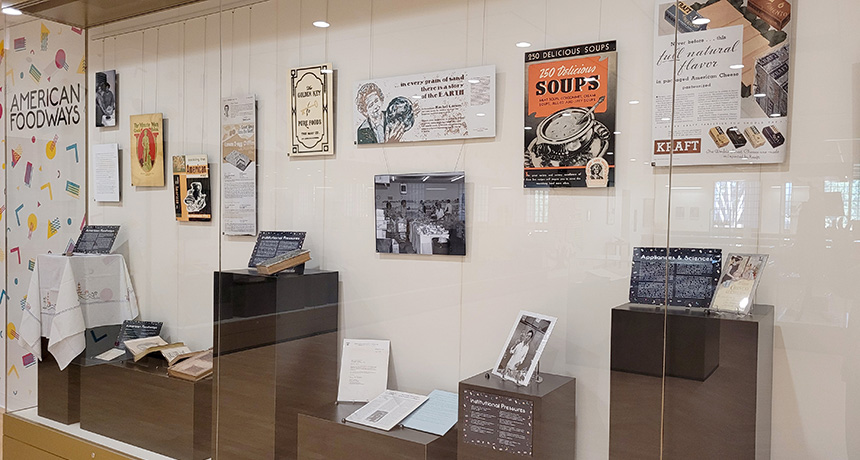
American Foodways section of the exhibit, featuring advertisements, photos and culinary books.
What geographic and cultural scope does the exhibit cover?
Eating the Archives looks at American foodways, primarily from the late 19th through the 20th centuries. The term foodways encompasses what we eat, how we grow it, how we prepare it, and how it relates to our culture. Critical to a reflection on foodways is the means by which we establish and communicate our practices – formal cookbooks, periodical recipes, marketing souvenirs, family recipe cards and oral tradition. I tried to include as many different American perspectives as our gallery space allows, but of course there are many stories still left to be told! And since our archival collections preserve many artifacts of our own state’s cultural, economic and political past, this exhibit highlights a lot of Western American perspectives, with many items relating to California.
What does the exhibit tell us about how food has shaped California history?
This exhibit highlights the integral role California plays in our nation’s food supply. This is both from the general perspective of how we grow a lot of the nation’s foodstuffs, and also in the way California producers and consumers have alternately ignored and responded to the impact difficult working conditions and low wages have had on the people that work to grow, manufacture, and transport our food. The “Labor” case features items from the 20th century farm workers movements, including the 1965 Agricultural Workers Organizing Committee-organized Delano grape strike. The agricultural labor movement touched CSUN too – in 1970 the Associated Students urged a boycott of Valley State food services for using lettuce from Northern California farms exploiting lettuce workers. Food also substantially shaped California’s identity in the early 20th century boosterism period, when new housing developments used orange and avocado grove imagery to sell new suburban homes.
"Foodways and Identity" is one of the major themes of this exhibit. Can you talk a little bit about that?
The “Foodways and Identity” south wall case explores influential food factors that shape our knowledge of and relationship with food as Americans. Food is more than just a recipe – it is part of our fluid identities. It’s something we are taught, something we bring with us, and something that changes over time. Food influences how we see ourselves and those around us. And through our innovations and migrations, we make food as much as it makes us. How did an initial broad "American" food identity begin to emerge? What kind of institutional influences, often pressured into existence by concerned Americans, shape food regulation, food access, food contamination? Materials in the “Institutions” section ask us to consider consumer protection laws and the systemic economic forces that determine what we are actually able to access on an individual local level. Artifacts in the “Appliances and Sciences” section suggest how the technological advancements that enable us to have frozen food, or to cook food on new appliances, might inform our lifestyle and economic identities. Finally, American Foodways looks at ways that globalization and immigration expand American food horizons. All these elements create a palette we draw from to shape our own individual food palates.
Will we recognize any foodie personalities in this exhibit?
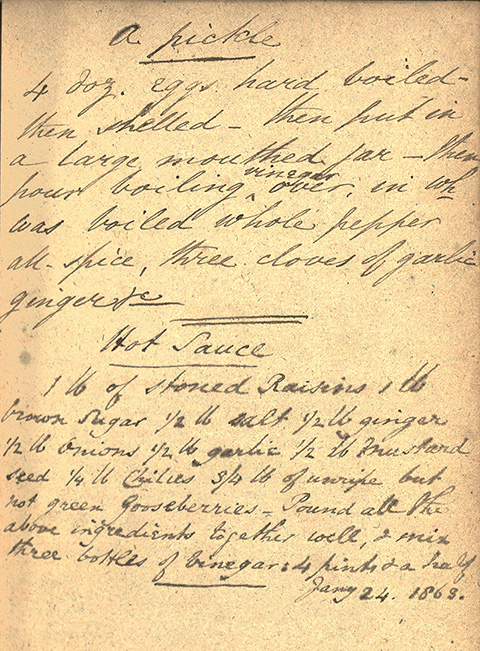
Handwritten recipe card for pickled eggs and hot sauce.
I focused less on specific influencers. Familiar names like Julia Child, Fannie Farmer, Betty Crocker, and James Beard do appear in the cookbook case, but I wanted to elevate the stories and recipes of non-famous individuals. You’ll see some of these in the recordings made by students in Bess Lomax Hawes’ CSUN folklore classes in the 1960s and 1970s, which preserve instances of oral transmission of food knowledge, as well as in the individuals named in handwritten recipes. Some of my favorite items in the exhibit are the handwritten recipes – some on recipe cards, others scrawled on scraps of reused paper. These recipes passed down for generations show us what was valued and worth recording and sharing. This exhibit focuses more on food’s appearance in our daily lives than on trending food.
How do you think Eating the Archives might be incorporated into CSUN instruction?
The exhibit showcases how many different material formats can contribute to a critical examination of specific food-related topics, as well as the importance of considering context and bias when evaluating information sources. The “Appropriation & Discrimination” case demonstrates that just because something was printed and widely distributed, doesn’t mean that it’s recording a lived truth. A Date with a Dish: A Cookbook of American Negro Recipes was written by Freda De Knight, a Black American, who spent twenty years collecting "over a thousand wonderful recipes from Negro sources." Her book centers the humanity and dignity of her food sources. In one example, she describes the recipes of Pauline, a daughter of caterers, and Charlie Saunders, a chef on a private rail car. This is in contrast to white author Patsie McRee's rhapsodizing about a mythical "Old South" in The Kitchen and the Cotton Patch through dehumanizing portrayals of her impressions of the enslaved Black people on her family's plantation. It’s important to look critically at who is telling a specific story, and what kind of contextual factors and motivators will influence that person’s perspectives.
What did you have to leave out of the exhibit and why?
There are some really fun photographs in the Richard Fish Collection from a shoot Fish did featuring craftspeople that create realistic-looking food art. The shoot included cast members from the 1970s television show Fantasy Island and was titled “Fantasy Food.” Fish also photographed vehicles shaped like a tomato and a cucumber, and I really wanted to get those in there! On a more serious note, if I had more space in the exhibit I would’ve liked to spend time exploring the impact of Japanese American farmers in the San Fernando Valley, as they played an important role in early 20th century Southern California farming. I would’ve also liked to more deeply explore the idea that progress isn’t linear. Plastic packaging and a transportation revolution allowed us to break produce free of seasons and have wide-ranging choices of pre-prepared foods in the freezer aisle, but many Americans are starting to look more closely at the ways our current food system is negatively impacting the environment.
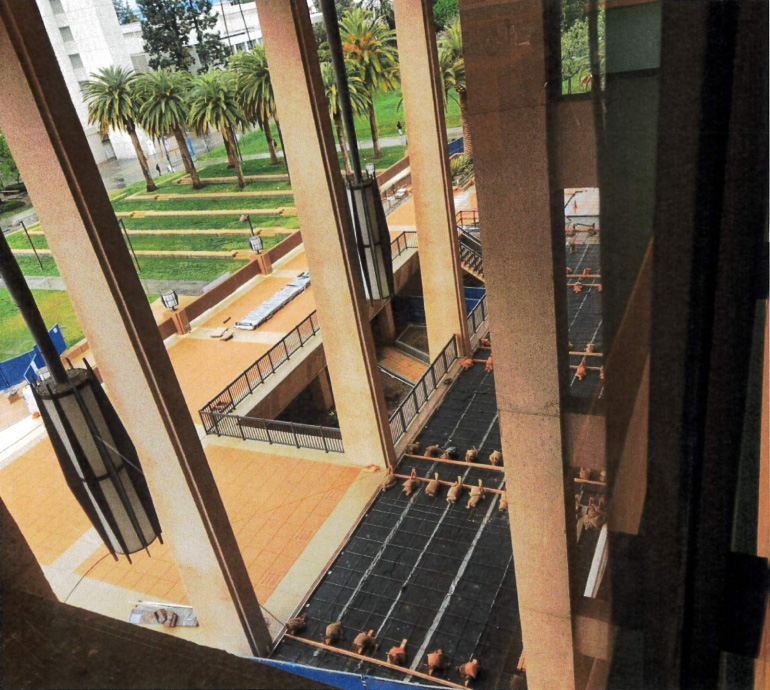
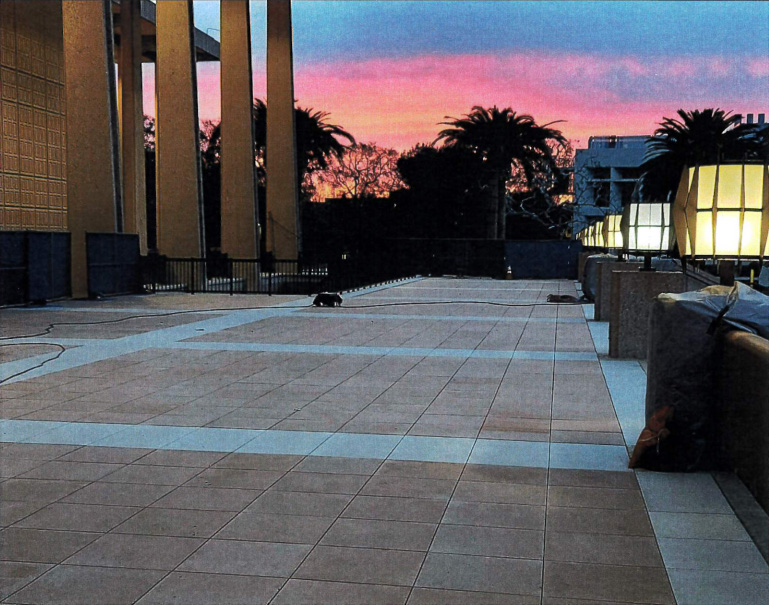
A view of the South Portico from the Library with new pavers, planters and palm trees.
The iconic University Library at California State University, Northridge is celebrating its 50th anniversary this year. It sits in the center of campus and the Library’s Mission, Vision and Values describe it as “the intellectual heart of the CSUN campus.” With its striking grand staircase and unique architecture (designed by architecture firm Leo A. Daly), it is a building that catches the eye and welcomes you in. As Library services evolve, so does the Library.
In recent memory, the Library has improved upon its spaces for students, faculty and staff, with projects such as the Learning Commons on the Main Floor of the Library with a variety of configurable study spaces, the Freudian Sip café, our fabulous Creative Maker Studio, and Library Technology Services (which facilitates the campus’ Laptop Lending Program). Other improvements in recent years include a redesigned Special Collections & Archives space with archival storage, and the development of a Quiet Study Lounge. Library book stacks were removed on the second floor to create a spacious study space.
Originally built in 1973, the march of time has taken its toll. The South Portico of the Library was beginning to show its age: there were issues of water leaks in the tiles and planters at either side of the Library, as well as other wear and tear to the infrastructure.
View of the portico, grand staircase and lawn near the entrance to the Library.
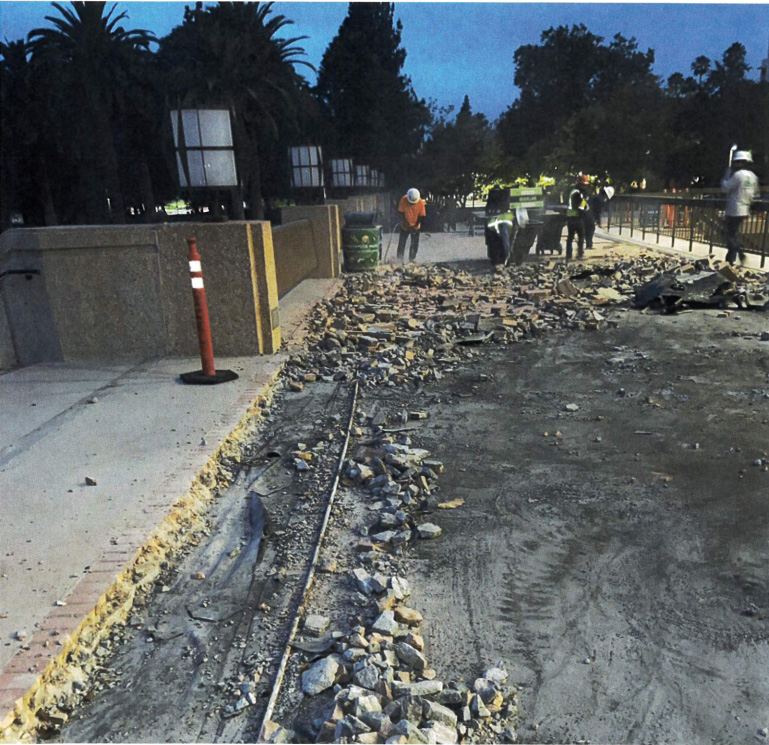
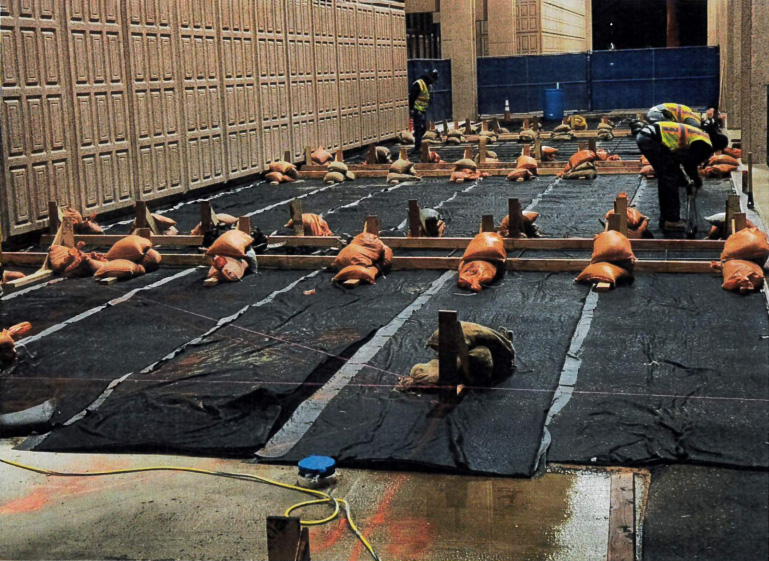
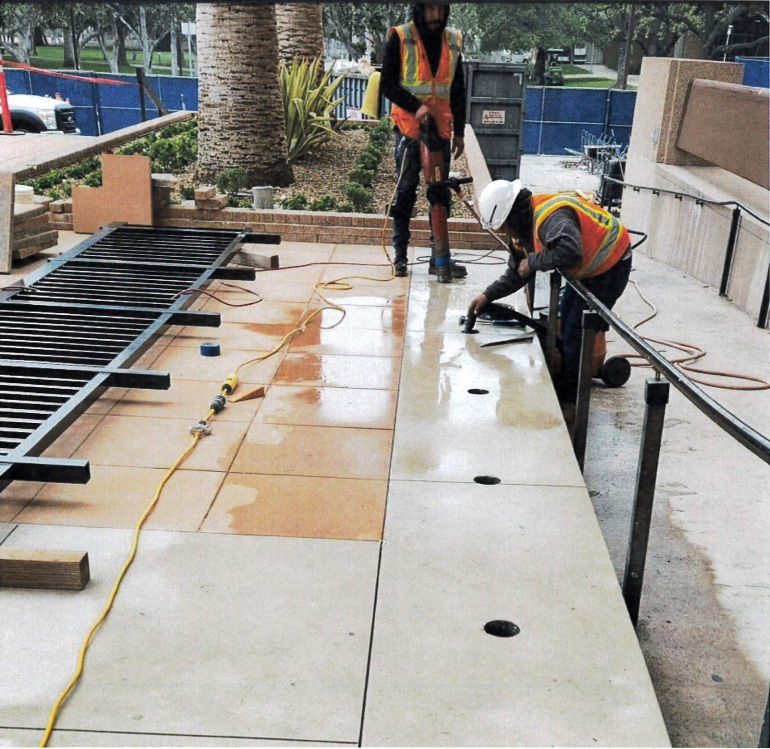
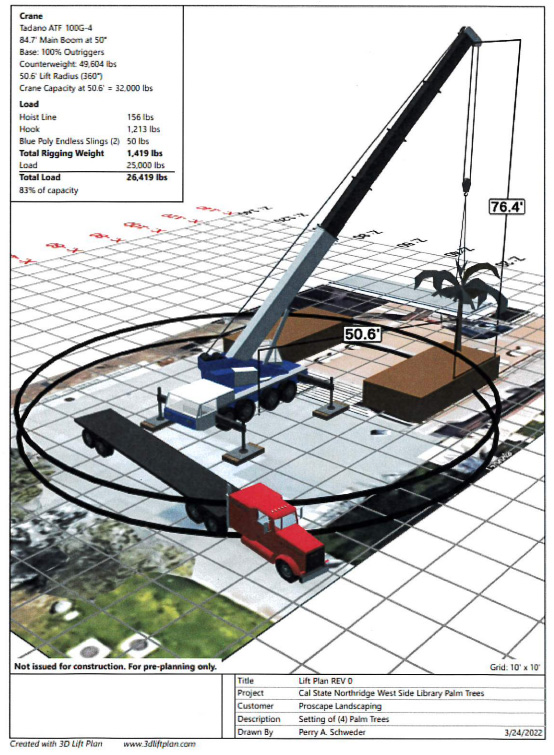
The portico and grand staircase renovation project began in early June 2021. The areas targeted for renewal were sealed off by fencing and an entrance was left open on the west side of the Library. Crews began to demolish and remove tiling and the east and west planters in preparation to put the new infrastructure and pavers in place. There were a few issues that prolonged the project, such as the discovery of additional water damage and structural problems, and there were the inevitable supply-chain issues caused by the COVID-19 pandemic. The enclosure not only affected foot traffic, but also events that had been planned around the portico, including graduations, which were modified to take into account the construction. And we eventually were able to use the construction webbing as a canvas to promote Library services and events. As time went on, real progress was being made. When the planters were replaced, a giant crane came and planted our new beautiful palm trees. The planters and furniture on the Garden Level of the Library were also redesigned, and additional structural improvements were made. You can see pictures of the demolition and construction in our image gallery at the bottom of the article.
In April of 2023, the portico and grand staircase reopened and visitors could enjoy the newly renovated Library portico which features the new paver tiles, improved railings, and something new to the Library, programmable colored LED lights which can be changed depending on the holiday or occasion. The final touches of the reconstruction were to add new concrete furniture, and the project officially wrapped up in August of 2023. Students, faculty, staff and the community can now overlook the CSUN campus once again from our newly renovated and beautiful South Portico at the heart of the campus.
We look forward to future graduation commencements and events taking place in the beautiful new space. As part of our celebration of the Library’s 50th anniversary, we will soon be announcing our University Library 50th Anniversary Paver Fundraiser. Donors will have the opportunity to have a paving stone engraved with their name or message to the campus included in the South Portico for future and past generations of the CSUN community to see. We will be promoting this in the near future, so keep an eye out, or come check back here in this article for details as they become available. In the meantime, other donations help fund the many services and programming we offer at the Library, so please feel free to check out our Giving Home at CSUN.
As the calendar marks another year, the CSUN University Library (formerly known as the Oviatt Library) approaches a historic milestone—the 50th anniversary of its opening on October 24, 1973. From its inception to its current status as a dynamic hub for learning, innovation, and collaboration, the University Library has seen significant transformations, triumphs, and challenges. This retrospective provides a lens into the Library's rich history and architectural growth, its recovery from natural disasters, and its continuous innovation over the last half-century.
Land Acknowledgement
California State University, Northridge (CSUN) proudly recognizes and acknowledges the Sesevitam, the first people of this ancestral and unceded territory of Sesevenga, which is now occupied by the University. It honors their elders, past and present, and the Sesevitam descendants, who are citizens of the Fernandeño Tataviam Band of Mission Indians. We recognize that the Sesevitam are still here, and we are committed to lifting up their stories, culture, and community.
The Backstory: 1956-1971
On September 24, 1956, the then-San Fernando Valley satellite campus of Los Angeles State College of Applied Arts and Sciences (now California State University, Los Angeles) held its first classes, and Library service began in bungalow "J," located next to what would become the Student Union on Lindley Ave. Between 1957 and 1958, the growing Library needed to rent a former meat market on Reseda Blvd and use a hayloft in a stable at Devonshire Downs for storage. On July 1, 1958 the SFV satellite campus became San Fernando Valley State College (SFVSC).
On March 3, 1959, the San Fernando Valley State College Library, the first permanent building on campus, opened with 75,000 volumes and services located on the first two floors of the four-story building, and by 1967, the Library occupied all four floors of the building.
The Birth of a Vision: 1970s
The roots of the CSUN University Library building can be traced back to May 19, 1971, when the groundbreaking ceremony was held. It was initially named the Delmar T. Oviatt Library, after the prominent CSUN figure. Architect Leo A. Daly was commissioned for the project, with a budget of $7.5 million. In 1972, San Fernando Valley State College became California State University, Northridge (CSUN). By October 24, 1973, the date we now celebrate as the 50th Anniversary of the University Library, the first phase was completed and the Oviatt Library opened, boasting 137,896 net square feet and a seating capacity of 1,674.
The old Library (called South Library) remained in operation but housed only the Science collection and services, University Archives, Urban Archives, the Instructional Materials Laboratory, and Technical Services, and continued as such until the opening of the Oviatt Library’s wings.
Expansion and Upgrades: The Early 1990s
By 1991, the second phase of the University Library—the addition of wings on the east and west side of the main building was completed, again under the supervision of Leo A. Daly and with Kiewit Construction as the contractor. This extension cost $18.4 million, bringing the total square footage to 234,712.
With the addition of the wings, the CSUN University Library became home to an innovative Automated Storage and Retrieval System (AS/RS), the first of its kind for libraries. Built in 1991 at a cost of $2 million, the AS/RS consists of 13,260 steel bins of varying heights, organized in a rack structure that spans 8,000 square feet and stands 40 feet high. These bins are located in six aisles, each of which has a Storage and Retrieval Machine (SRM) or robotic crane to facilitate item retrieval. The AS/RS continues to be a popular destination for tour groups from both the local area and international, and the AS/RS Viewing Room, from which one can often see the robotic cranes zipping toward their targeted bin, is a popular place to study.
The system can store an estimated 1.2 million items, sorted by height and type, and is currently at 67% of its capacity. Items in the AS/RS can be requested via the Library OneSearch tool, and the requested materials are usually available for pickup at the Guest Services Desk in less than ten minutes.
Although the AS/RS was initially equipped with software developed in the late '80s and early '90s, it has undergone three major upgrades since its inception. These upgrades, completed in 2011, 2019, and 2021, focused on improving the SRMs' controllers, communications, positioning, and safety infrastructure.
On January 17, 1994, a devastating 6.8 magnitude earthquake struck Northridge, severely damaging the Library, and forcing its closure. During the earthquake, 90 percent of the open-shelf collection fell onto the floor and the original Library building, known as the “core” was substantially damaged and was closed indefinitely. But as adversity often reveals character, partial services almost immediately resumed in trailers parked next to the Library, and then CSUN President Blenda Wilson prioritized its reconstruction, recognizing the library’s significance as an integral campus structure. By spring, 1994, three temporary buildings containing 31,000 square feet of library space opened up at a cost of almost $2.5 million dollars to house Library Technical Services, specialized collections and services, and study spaces that had formally been in the recently built east and west wings.
By the fall of 1994, the Library’s core was restored at a cost of $11 million and services were restored, but the wings, which were beyond repair, remained closed, and had to be partially torn down in the summer of 1997. By July 1998, reconstruction of the wings began at a cost of $22 million, and by July 2000, the Library completed its move back into the newly rebuilt wings. At the same time, the Library was approved to build a grand staircase at the south end of the portico and add terracing to the lawn, both of which added to the iconic architecture of the University Library, which continued to be a location of several commercial films and campus publicity campaigns. On September 26, 2000, the rededication of the Oviatt Library and re-opening of the wings ceremony was held.
Transforming Library: 2012-2023
The Learning Commons
Students collaborating in the CSUN University Library Learning Commons
Completed in the summer of 2013, the first-floor Learning Commons was the first major renovation of the Library since the wings re-opened in fall 2000, and it is a cornerstone of the Library’s plan to encourage academic success by combining critical research and technology services to support coursework, scholarship, and co-curricular enrichment in a welcoming, collaborative environment with modern furnishings and technology. The Information Technology Service Desk assists students, faculty, staff, and visitors with accessing the campus network and other resources. As part of the Learning Commons renovation, a new, permanent Freudian Sip coffee shop was built in the lobby, offering Starbucks® drinks, and pastries and other food items, which can be enjoyed almost anywhere in the Library.
The fall of 2013 saw the move of the campus Learning Resource Center (LRC) into the University Library, now situated on the third floor, East Wing. The LRC offers workshops, one-on-one and group tutoring, and supplemental instruction classes to help CSUN students develop effective study strategies, improve writing skills, and excel in subject-matter courses. Through its mission and services, the LRC joins the University Library in a strategic partnership and commitment to fostering an environment of academic excellence and lifelong learning.
Library Technology Services & Creative Maker Studio
Among its many services, the Library Technology Services desk helps with free self-service scanning, student lab printing, desktop computers, and loans out laptops, tablets, hotspots, and related devices and other technical accessories. Beginning in fall 2023, the LTS took over CSUN IT’s Device Loaner Program to checkout laptops/tablets, Internet hotspots, and webcams to CSUN students who are lacking these critical resources at home.
The Creative Maker Studio (CMS), built in 2014 thanks to Campus Quality Fee funding, is an exploratory space where students of any major can have access to hands-on multimedia design and production tools for learning new technologies, prototyping, collaboration, and digital creation/modeling/editing at no additional cost. Also, paid for out of CQF funding, the CMS has 3D printers, sewing machines, audio recording and video production studios, crafting equipment, 3D scanning, and a virtual reality room, offers access to software for engineering and film/audio projects, and loans out multimedia devices. Available to current CSUN students only, the CMS can be used for coursework or leisure, or career exploration of makerspace equipment and services.
Students utilizing the Creative Maker Space (L-R) Using the recording studio, checking out a camera with 3D printers on the back wall, using the sewing room, and exploring Virtual Reality.
Robert and Maureen Gohstand Leisure Reading Room
The Robert and Maureen Gohstand Leisure Reading Room, located on the West Wing's second floor, was refurbished in fall 2013 to offer a dedicated space for leisure reading. A haven for those looking to escape academic rigors, this room, formally dedicated in October 2014, continues to develop its collection for the comfort and benefit of readers.
Special Collections & Archives
January 2018 marked the grand reopening of the Special Collections and Archives, after two years of renovations funded by private donors. The newly expanded department provides twice the space for its unique collection of 50,000 cataloged items, housed in a temperature and humidity-controlled high-density storage facility. The remodel includes a wood-paneled Reading Room with floor-to-ceiling windows, offering an inviting space for research.
In 2020, also funded by private donors, the Library Exhibit Gallery’s beautiful but difficult to maintain green and rust cork flooring was upgraded to easy to maintain Luxury Vinyl Tile (LVT) flooring in a light maple shade that creates a bright, airy, and modern environment for Special Collections & Archives exhibits.
Teacher Curriculum Center/Music & Media Merger
The summer of 2018 saw the renovation of the Music & Media department to accommodate the Teacher Curriculum Center. The newly combined department, known as Teacher Curriculum Center/Music & Media (TCC/M&M), is a dynamic and comfortably furnished environment catering to a wide array of academic needs. The collections support K-12 teaching and learning, including curricular materials, manipulatives and games, and children’s books; and music books, scores, and physical sound recordings, and physical audiovisual media, which compliments the Library’s extensive collection of instructional media databases.
Room 26 and the Map Collection
Students looking over maps in the Unviersity Library Map Collection.
Another notable renovation occurred between 2018-2019 when Room 26 on the Garden Level was redesigned to house the University Library Map Collection, accessible from the northeast stairwell or the Learning Commons' East Wing elevator. The University Library Map Collection contains over 400,000 historical and government maps, aerial photographs, and atlases that mostly focus on Western Americana, but include other states and international maps, too. Additionally, the Map Collection provides computers for accessing geospatial data that support student and faculty research on campus and outside researchers.
Other Collections Added to the University Library
Established in 1978, the NCOD Resource Center initially served as a standalone repository at CSUN for one of the nation's largest collections of deaf-related materials, including books, journals, dissertations, videotapes, DVDs, CDs, and documents. Often referred to as the "Deaf Library" by students, faculty, and community members both within and outside the CSUN campus, the center has been a pivotal resource. In 2016, the NCOD Resource Center underwent a significant transition when its collections and staff were integrated into the CSUN University Library. This move not only ensured the preservation of these invaluable resources but also expanded access to a broader audience, leveraging the University Library's infrastructure to better serve the needs of those interested in deaf education and research.
Along with the NCOD Library, other significant collections have been integrated into the University Library over the past 25 years, including the Tom and Ethel Bradley Center Archives; the International Guitar Research Archive (IGRA); the Old China Hands Archive; the Harry Stone Charles Dickens Collection; the Sharon Fogarty Young Readers' Collection; and the Karin J. Duran Teacher Curriculum Center Collection. The addition of these important book and archival collections to the CSUN University Library over the past three decades significantly enriches the educational experience for students, faculty, and the broader community. These collections serve as invaluable reservoirs of knowledge and research, offering diverse perspectives across various fields and disciplines. For students, they provide essential resources for academic exploration and scholarly work. Faculty members benefit from enhanced research opportunities, while the community gains access to a wide array of informational and cultural assets that promote lifelong learning and civic engagement. Overall, these collections elevate the intellectual and cultural vitality of the university and its surrounding community.
Infrastructure and Furniture Upgrades
Recognizing the need for improved accessibility, the Library modernized its elevators in the core facility, a project completed in the spring of 2016. This overhaul not only replaced mechanical systems and cabling but also refurbished the interior of the elevator cabins.
With over 10,000 fluorescent interior lightbulbs, each drawing around twenty-five watts of power, and a number of other high-wattage bulbs around the library’s exterior, by the end of 2020 the University Library’s lighting was upgraded with LED alternatives, representing significant electricity savings and lowering greenhouse gas emissions for CSUN each year.
From 2021 to 2023, the Library’s south portico and hardscaping underwent major renovations due to perennial rain water leaks into the interior of some areas of the garden level and other critical upgrades. After many months of being surrounded by construction fencing and equipment, the portico emerged with upgraded tiles that complement the original bricks, which are still located on the east, west, and north sides of the Library.
As part of the second phase of creating a welcoming and collaborative study environment like the Learning Commons, in 2022, the Library finished upgrading the carpeting and study furniture on the second floor core to encourage a collaborative and welcoming environment that complements the main floor Learning Commons. In the interest of supporting individual study, the fourth floor east wing was renamed the Quiet Study Lounge, and old study tables and seating are in the process of being replaced with semi-private study “pods” that are equipped with comfortable seating for one and built-in power to meet the needs of students who need a quiet, distraction-free environment for studying and using their laptops and other devices.
A New Chapter: The Name Change
In December 2020, the Library was renamed from Delmar T. Oviatt Library to University Library, following recommendations outlined in the Report of the Oviatt Library Advisory Working Group (PDF). The change was approved by multiple governing bodies, signifying a new era for this central institution.
Vast Collections and Services
Today, the CSUN University Library continues to play a multi-dimensional role in the university. Apart from supporting traditional academic pursuits through its large collection of approximately 2 million book titles, 200,000 journal and serial titles, and 100,000 media titles, in physical and electronic formats, the Library provides a rich array of resources, including over 250 premier subscription databases, specialized collections, and archival resources in physical and digitized formats to support and facilitate classroom and independent learning, student and faculty research, and community and cultural engagement.
In 2021/22, usage of all physical and electronic collections totaled about 2 million checkouts. Despite being open less hours for part of the year or with most students attending at least some of their classes online, the Library still had over 300,000 entries to the building and 2.8 million webpage views, provided instruction sessions to over 17,000 students, and answered 4,700 questions. As CSUN and the University Library continue to recover from the pandemic, these numbers are expected to grow.
The Road Ahead
As the CSUN University Library looks forward to the next 50 years, we carry the legacy of resilience, innovation, and academic excellence. With each renovation, upgrade, and community endeavor, we renew our commitment to serving the ever-changing needs of our diverse patron base. The retrospective journey from our modest beginnings in 1973 to the multifaceted institution today gives us a moment to celebrate, reflect, and anticipate the ongoing saga of this vital academic resource.