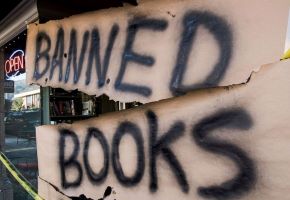
In recent years, book bans and challenges have become a major area of public discourse. Banned books were once a more niche topic, mostly discussed amongst librarians, educators, writers, and publishers. However, a surge of challenges and bans across the United States, focused largely on books by and about marginalized people, has pushed the issue into public attention.
[content_block id=6472 slug=banned-books-2022]
On Thursday September 29th (the day after this blog post is published), CSUN will host its 10th Annual Banned Books Readout: Belonging on the Shelf featuring writer and teacher Karimah Tennyson-Marsh and co-sponsored by the University Library, the Department of Journalism, the Queer Studies Program and the Pride Center. Understanding the nuances of book challenges and censorship, this event will showcase the importance of resisting book bans through dramatic readings.
Hearing the phrase “banned book” might feel old-fashioned in many ways. Often people invoke Fahrenheit 451 and the image of book burnings, or refer to now widely-taught texts like Catcher in the Rye or Catch-22. These books still face challenges and bans across the country, of course. However, it’s worth pointing out that in 2021, the most challenged/banned book was Gender Queer by Maia Kobabe, and that The Bluest Eye by Toni Morrison has shown up as a frequently-challenged book since its publication.
Often, bans are presented within a framework of protecting student and children interests; what they do instead, is erase the ways students can encounter themselves or other human experiences. In some cases, the students themselves are the ones pushing back against bans.
In the growing area of study around who challenges books and why, the work of Emily Knox has emerged as a foundational text for research and understanding. You can access a digital copy of Book Banning in 21st-Century America through the CSUN library, or hear her discuss her research with a panel of library workers on the podcast librarypunk.
[content_block id=6484 slug=emily-knox-book-banning-ebook]
As reading icon LeVar Burton used to say, “Don’t take my word for it.” Check out some banned books for yourself! You can access digital copies of the Top 10 most challenged books in 2021, as well as other historically and frequently banned books, through the Los Angeles Public Library, or explore the research and discourse around challenged books in the University Library catalog.
Happy reading! 🔥
References:
Alfonseca, Kiara. “Students Protest Book Bans by Distributing ‘Maus,’ ‘Beloved.’” ABC News, https://abcnews.go.com/US/students-protest-book-bans-distributing-maus-beloved/story?id=82622456. Accessed 28 Sept. 2022.

The distinction between old images of censorship, such as book burnings, and today’s challenges targeting books by and about marginalized people is especially important. CSUN’s Banned Books Readout shows how dramatic readings can restore the voices and human experiences that bans attempt to erase. A resource like AI Quote Generator could also help readers create thoughtful lines for displays or discussions about intellectual freedom.
This was a useful read, especially the practical framing. It fits naturally beside related web resources like Numberblocks Generator Websim.
The point that book bans can erase opportunities for students to encounter their own lives and other human experiences is especially important, particularly given the challenges to books like Gender Queer and The Bluest Eye. Making research and discussion accessible across languages can also help more people engage with these debates, and FunTrans may be useful for translating related materials.
The concrete examples make this easier to apply. Readers comparing related resources may also find Bombanana マニュアル useful in this context.