


Immigrant communities have helped cultivate farms, maintain public parks, restore landscapes and care for the environment. Yet their contributions are often overlooked in traditional and white-centered accounts of environmentalism.
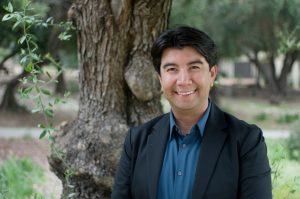 In Stewards of the Land: Race and Reclaiming Environmental Labor in the American West, Professor Ruiz discusses how Asian migrants and Chicana/o workers helped shape agriculture, conservation and the park system throughout the American West. The book argues that environmental history cannot be separated from the histories of immigration, race and labor. “I was really interested in being able to use labor as a lens,” he said.
Professor Ruiz was influenced by his mother, who worked as a janitor for the state parks for more than 20 years. Although she possessed extensive ecological knowledge and cared for the park spaces every day, she was rarely recognized as an environmentalist.
“They would go to the ranger, and the ranger would be seen as the authority,” Professor Ruiz said. “But my mom was a janitor, and she was the one that was caretaking that space and that land.”
This helped inspire the book’s central purpose, that is, to make the work of immigrant communities visible and to honor their knowledge and contributions. Additionally, he explained that Stewards of the Land was written with students in mind, particularly those beginning their studies at a community college or university.
The book presents environmentalism as a movement connected to immigration, labor rights and Ethnic Studies. It also challenges readers to understand how the treatment of one racial or ethnic group has influenced the treatment of others.
This interdisciplinary approach draws from Chicana/o Studies, Asian American Studies, American Indian Studies and the history of science. For Professor Ruiz, these fields provide essential perspectives for understanding how communities adapt and apply traditional ecological knowledge in new environments.
“They bring that ecological knowledge with them from their home countries,” Professor Ruiz said, describing the immigrants and day laborers who contribute to drought-tolerant landscaping and other environmental work in Los Angeles.
When asked about the book’s connection to Latinx Heritage Month, the author expressed hope that Latinx students would recognize their longstanding history of environmental stewardship.
“I want students to understand that they come from a long heritage of people protecting the environment and putting their lives on the line,” Professor Ruiz said.
Furthermore, it’s important to note that teaching played a significant role in the development of the book. In courses such as Chicana/o Studies 261: Race, Racism and the Sciences and Chicana/o Studies 467: Environmental Justice, Professor Ruiz has explored the relationship between communities of color and the environment. Students helped shape his research by asking questions about their own communities and histories.
After reading Black Faces, White Spaces: Reimagining the Relationship of African Americans to the Great Outdoors by Carolyn Finney, students asked why there was not similar work documenting Mexican American experiences.
“They would say, ‘We want a book like this too,’” Professor Ruiz said. “We have that same type of relationship.”
That response inspired a chapter on Mexican Americans in the Civilian Conservation Corps (CCC). Although the history of race in the CCC has often been examined through a black-white framework, the author found evidence that Mexican Americans also participated in the program.
While researching the National Archives in Maryland, Professor Ruiz consulted historian, Olen Cole, whose work about African Americans in the CCC referenced Mexican American participants in several camps. Cole explained that records identifying workers as “W1” and “W2” reflected two racial classifications of whiteness: Anglo whites and Mexican Americans, who were legally classified as white but viewed as a distinct racial group.
This insight helped the author identify Spanish surnames in the archives and uncover evidence of Mexican American participation in the CCC. The experience also reinforced the importance of interdisciplinary research.
“You can’t talk about race in America without talking about the history and treatment of African Americans,” Professor Ruiz said. “You can’t talk about the history of immigration if you don’t talk about Asian Americans.”
Overall, Professor Ruiz hopes the book inspires readers to take action on climate change while recognizing that environmental issues are inseparable from the treatment of immigrants and other marginalized communities.
“We have to stop climate change,” Professor Ruiz said. “The way to do that is we need to treat immigrants better, respect our nonhuman world and learn to respect all communities.”At the same time, the author cautions students against becoming overwhelmed by the many social justice issues facing society.
“Everyone has to pick one,” Professor Ruiz said. “You can’t do everything.”
The author encourages students to focus on the issue they care about most while learning from other movements. Environmental activists, organizers for reproductive rights and advocates for prison abolition, for example, can share strategies and ideas.
Ultimately, Stewards of the Land asks readers to reconsider who belongs in the history of environmentalism. By highlighting the workers and communities who have long cared for the land, he offers a broader understanding of environmental stewardship—one that recognizes immigrant communities not only as people affected by environmental crises, but also as leaders in the work of protecting and restoring the environment.
Recommended resources
For students interested in learning more about environmental justice, Professor Ruiz recommends a range of books and films, including:
- The Garden — Documentary about the South-Central Farm and community gardeners in South Los Angeles.
- Flint’s Deadly Water — Frontline documentary about the water crisis in Flint, Michigan.
- No Cop City, No Cop World by Micah Herskind — Book connecting environmental justice and prison abolition.
- Black Faces, White Spaces by Carolyn Finney — Book about African Americans’ relationship with the outdoors.
- The African-American Experience in the Civilian Conservation Corps by Olen Cole — Historical book about African Americans and the Civilian Conservation Corps.
- The Mustang — Film about incarcerated men, rehabilitation and their relationships with wild horses.
- Environmental justice scholarship related to Palestine, including land, ecological destruction and the protection of olive trees.
For Professor Ruiz, these resources demonstrate that environmental justice is not a single-issue movement. It is connected to questions of land, labor, migration, public health, democracy and human dignity.
(The interview has been edited for length and clarity)
