
Newsletter Edition: Spring 2026
Contributed by David Morck
Back on campus, creativity is thriving in hands-on, unexpected ways. At the CSUN University Library, zines have become a space where students, staff, and community members come together to share ideas, tell stories, and explore issues that matter to them.
Zines—short for “magazines” or “fanzines”—are self-published, small-run works that have long been a way for people to share ideas outside of mainstream publishing. They’re often handmade using whatever tools are available, like paper, scissors, glue, and photocopiers, and passed around through informal networks, events, and community spaces.
Instagram Post Promoting the Lisa Bishop Event
Zines have roots in science fiction fan communities of the early 20th century, but really took off during the punk movement of the 1970s and 80s. Since then, they’ve been a powerful outlet for voices that aren’t always represented in traditional media. Zines have played an important role in feminist, queer, Black, Indigenous, and working-class communities by offering space to tell stories, share experiences, and organize around social and political issues.
What makes zines especially meaningful is how they capture history from the ground up. Rather than presenting a polished, official version of events, they reflect lived experiences in real time. As historian Lucy Robinson writes in Ripped, Torn and Cut, zines are "an invaluable way into the messy traces left by subcultures, DIY and fan cultures, and the politics of identity."
They also help fill in the gaps. Zines often highlight stories and perspectives that don’t always make it into textbooks or mainstream narratives. They offer alternative ways of understanding history and community. In that sense, they are not just creative projects. They are tools for documenting, questioning, and reshaping the world around us.
Zines as Tools for Advocacy, Resistance, and Wellness
In Fall 2025 and Spring 2026, the CSUN University Library hosted a series of zine-making workshops that brought these ideas to life.
Zine-Making for Advocacy and Activism Workshop (September 23, 2025)
This hands-on workshop invited participants to explore zines as tools for advocacy and community awareness. Attendees learned about the radical history of zines while creating their own, focusing on issues they care about. The session also connected participants with Know Your Rights information and campus and community resources. These materials help individuals understand their legal protections and access support, especially in situations involving protest, housing, employment, or immigration. With guidance from librarian facilitators, participants developed ideas, gathered information, and designed their own self-published zines. No prior experience, or even a topic, was required.
Zine Making and Resistant Histories (November 18, 2025)
As part of Native American Heritage Month, this workshop focused on how zines can be used to document and uplift resistant histories. These are stories that are often left out of dominant narratives. Participants reflected on the histories and perspectives they wanted to share and began creating zines that highlight those voices. It was a reminder that history is not just something we study. It is something we can actively shape and share.
A Digital Detox: Hands-on Analog Zine Making Session with Lisa Bishop (February 2, 2026)
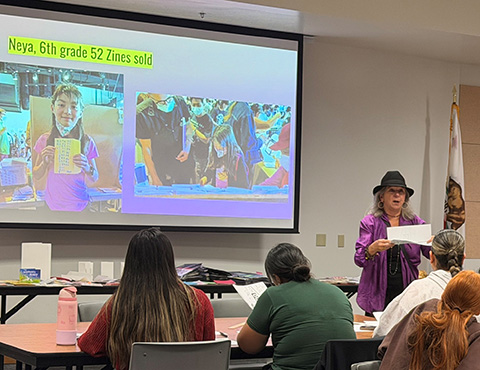
In both morning and afternoon sessions, participants unplugged from digital devices and focused on hands-on creativity. Led by Lisa Bishop, retired school librarian and zine educator, and funded by the Dr. Karin J. Duran and Richard Nupoll Education Librarian Endowment, this workshop explored the connection between zine-making, wellness, and creativity. Participants created their own foldable zines, contributed to a collective zine, and left with templates and resources to continue making. The session highlighted how zines can support advocacy, storytelling, and personal well-being, as well as incorporating zine making into teaching as a means to bring in student voices and address wellness.
Zines in Libraries and Archives
In recent years, libraries and archives have started to recognize how valuable zines are, not just as creative works, but as cultural and historical records.
Institutions like UCLA, Barnard College, and the British Library have built zine collections that preserve these often one-of-a-kind publications. These collections help document specific communities, movements, and moments in time, capturing perspectives that might otherwise be lost.
Zines can be tricky to collect and catalog. They are often handmade, sometimes anonymous, and not always dated. But that is also part of what makes them so important. As Robinson notes, zines create a kind of "bottom-up" history shaped by individuals and communities rather than institutions .
Looking Ahead at CSUN
With growing interest in zines across campus, there is exciting potential for the CSUN University Library to continue expanding this work. A zine interest group was formed at the Library to explore future possibilities which could include building a zine collection, supporting student-created publications, and offering more workshops, exhibits, and collaborative events.
Zines remind us that anyone can create, share, and preserve stories. Whether they are used for activism, storytelling, or personal expression, they offer a powerful way to connect with others and document the world from a personal, community-centered perspective.