Newsletter Edition: Spring 2026
Contributed by Lynn Lampert, Coordinator of Instruction & Information Literacy
As bibliographer for the Robert and Maureen Gohstand Reading Room Leisure Collection, I truly enjoy selecting fiction and nonfiction titles for CSUN students and promoting leisure reading as an act of self-care and intellectual growth in a distracted world. We live in an age of digital distractions, where leisure reading is more important than ever for personal growth and relaxation. Today’s readers are immersed in a world filled with digital notifications, social media feeds, and AI-driven content that can fragment attention and easily misinform. Choosing to sit down and read a book—slowly and voluntarily—is an act of focus, self-definition and self-care.
Our Reading Room offers CSUN students a space where they can think deeply, imagine freely, and encounter perspectives beyond their own. Reading fiction builds empathy and creativity by immersing readers in complex lives and experiences. Reading nonfiction invites curiosity and self-directed exploration, allowing readers to pursue questions that matter to them personally rather than academically.
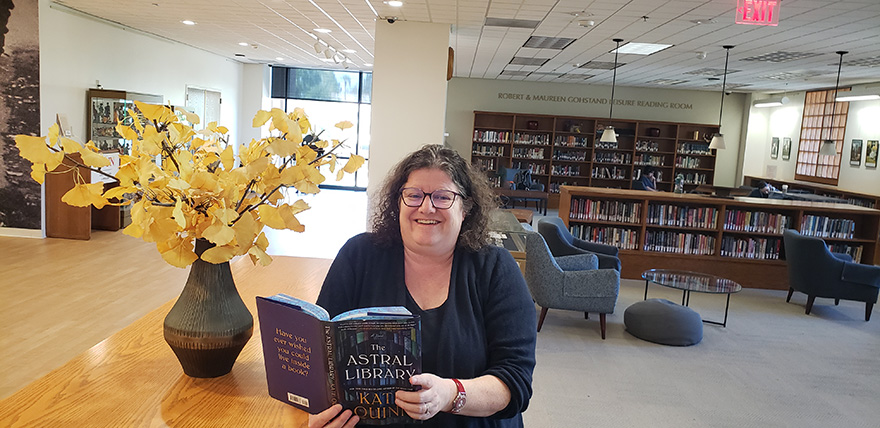
Reading has always been restorative for me. It provides a quiet refuge in a busy world and invites reflection and creativity. When I was young, my mother took my sister and me to our local public library each week, where we carefully chose the books we would take home. She also shared her own favorites with me, passing down book recommendations that I “must” read. One of those titles was A Tree Grows in Brooklyn by Betty Smith (1943), the story of Francie Nolan and her coming of age through hardship and imagination. A line from that novel has stayed with me and continues to shape how I think about reading and the importance of books is:
“From that time on, the world was hers for the reading. She would never be lonely again… Books became her friends and there was one for every mood.” — Betty Smith, A Tree Grows in Brooklyn
This sentiment still captures why I enjoy selecting books for the Reading Room. Books can offer comfort, companionship, possibility, and renewal. I hope everyone will take the time to come and visit the Robert and Maureen Gohstand Leisure Reading Room (Second Floor/West Wing of the University Library) and select a book to read. You won’t regret it!
Latest additions to the Reading Room Collection
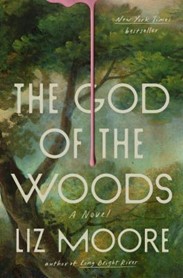
Moore, Liz. The God of the Woods. First U.S. hardcover., Riverhead Books, 2025
Location: Gohstand Reading Room ; PS3613.O5644 G64 2024
Summary
"When Barbara Van Laar is discovered missing from her summer camp bunk one morning in August 1975, it triggers a panicked, terrified search. Losing a camper is a horrific tragedy under any circumstances, but Barbara isn't just any camper, she's the daughter of the wealthy family who owns the camp--as well as the opulent nearby estate, and most of the land in sight. And this isn't the first time a Van Laar child has disappeared in this region: Barbara's older brother also went missing 16 years earlier, never to be found. How could this have happened yet again? Out of this gripping beginning, Liz Moore weaves a richly textured drama, both emotionally nuanced and propelled by a double-barreled mystery. Chasing down the layered secrets of the Van Laar family and the community working in its shadow, Moore's multi-threaded drama brings readers into the hearts of characters whose lives are forever changed by this eventful summer: Barbara's wounded, grieving mother; the "townie" whose family makes a living off this land; the 13-year-old camper struggling to find her way; and the outsider tasked with seeing the bigger picture, and uncovering the truth" -- Provided by publisher
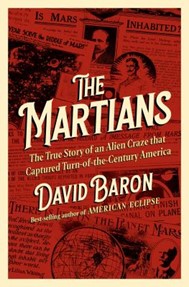
Baron, David. The Martians: The True Story of an Alien Craze That Captured Turn-of-the-Century America. First edition., Liveright Publishing Corporation, a division of W.W. Norton & Company, 2026.
Location: Gohstand Reading Room ; QB54 .B376 2025
Summary
"'There Is Life on the Planet Mars' (New York Times, December 9, 1906). This New York Times headline was no joke. In the early 1900s, many Americans actually believed we had discovered intelligent life on Mars, as best-selling science writer David Baron chronicles in The Martians, his truly bizarre tale of a nation swept up in Mars mania. At the center of Baron's historical drama is Percival Lowell, the Boston Brahmin and Harvard scion, who observed 'canals' etched into the surface of Mars. Lowell devised a grand theory that the red planet was home to a utopian society that had built gargantuan ditches to funnel precious meltwater from the polar icecaps to desert farms and oasis cities. The public fell in love with the ambitious amateur astronomer who shared his findings in speeches and wildly popular books. While at first people treated the Martians whimsically--Martians headlining Broadway shows, biologists speculating whether they were winged or gilled--the discussion quickly became serious. Inventor Nikola Tesla announced he had received radio signals from Mars; Alexander Graham Bell agreed there was 'no escape from the conviction' that intelligent beings inhabited the planet. Martian excitement reached its zenith when Lowell financed an expedition to photograph Mars from Chile's Atacama Desert, resulting in what newspapers hailed as proof of the Martian canals' existence. Triumph quickly yielded to tragedy. Those wild claims and highly speculative photographs emboldened Lowell's critics, whose withering attacks gathered steam and eventually wrecked the man and his theory--but not the fervor he had started. Although Lowell would die discredited and delusional in 1916, the Mars frenzy spurred a nascent literary genre called science fiction, and the world's sense of its place in the universe would never be the same. Today, the red planet maintains its grip on the public's imagination. Many see Mars as civilization's destiny--the first step toward our becoming an interplanetary species--but, as David Baron demonstrates, this tendency to project our hopes onto the world next door is hardly new. The Martians is a scintillating and necessary reminder that while we look to Mars for answers, what we often find are mirrors of ourselves" -- Provided by publisher.
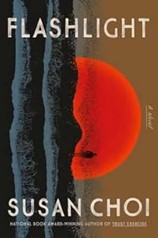
Choi, Susan. Flashlight: A Novel. First edition., Farrar, Straus and Giroux, 2026.
Location: Gohstand Reading Room ; PS3553.H584 F54 2025
Summary
"One summer night, Louisa and her father take a walk on the breakwater. Her father is carrying a flashlight. He cannot swim. Later, Louisa is found on the beach, soaked to the skin, barely alive. Her father is gone. She is ten years old. Louisa is an only child of parents who have severed themselves from the past. Her father, Serk, is Korean, but was born and raised in Japan; he lost touch with his family when they bought into the promises of postwar Pyongyang and relocated to North Korea. Her American mother, Anne, is estranged from her Midwestern family after a reckless adventure in her youth. And then there is Tobias, Anne's illegitimate son, whose reappearance in their lives will have astonishing consequences. But now it is just Anne and Louisa, Louisa and Anne, adrift and facing the challenges of ordinary life in the wake of great loss. United, separated, and also repelled by their mutual grief, they attempt to move on. But they cannot escape the echoes of that night. What really happened to Louisa's father? Shifting perspectives across time and character and turning back again and again to that night by the sea, Flashlight chases the shock waves of one family's catastrophe, even as they are swept up in the invisible currents of history. A monumental new novel from the National Book Award winner Susan Choi, Flashlight spans decades and continents in a spellbinding, heart-gripping investigation of family, loss, memory, and the ways in which we are shaped by what we cannot see" -- Jacket flap.
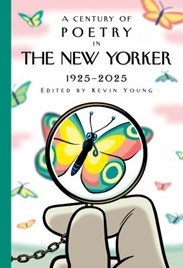
Young, Kevin, editor. A Century of Poetry in the New Yorker: 1925-2025. First edition., Alfred A. Knopf, 2026.
Location: Gohstand Reading Room ; PS586 .C44 2025
Summary
"Seamus Heaney, Dorothy Parker, Louise Bogan, Louise Glück, Randall Jarrell, Langston Hughes, Derek Walcott, Sylvia Plath, W. S. Merwin, Czeslaw Milosz, Tracy K. Smith, Mark Strand, E. E. Cummings, Sharon Olds, Franz Wright, John Ashbery, Sandra Cisneros, Amanda Gorman, Maggie Smith, Kaveh Akbar: these stellar names make up just a fraction of the wonderfulness that is present in this essential anthology. The book is organized into sections honoring times of day ("Morning Bell," "Lunch Break," "After-Work Drinks," "Night Shift'), allowing poets from different eras to talk back to one another in the same space, intertwined with chronological groupings from the decades as they march by: the frothy 1920s and 1930s ("despite the depression," Young notes), the more serious 40s and 50s (introducing us to the early greats of our contemporary poetry, like Elizabeth Bishop, W. S. Merwin, and Adrienne Rich), the political 60s and 70s, the lyrical 80s and 90s, and then the 2000s with their explosion of greater diversity in the magazine, greater depth and breadth. Inevitably, we see the high points when poems spoke directly into, about, or against the crises of their times-the war poetry of W. H. Auden and Karl Shapiro; the remarkable outpouring of verse after 9/11 (who can forget Adam Zagajewski's "Try to Praise the Mutilated World"?); and more recently, stunning poems in response to the cataclysmic events of Covid and the murder of George Floyd. The magazine's poetic influence resides not just in this historical and cultural relevance but in sheer human connection, exemplified by the passing verses that became what Young calls "refrigerator poems": the ones you tear out and magnetize to the fridge to read again and again over months and years. Our love for that singular Billy Collins or Ada Limon poem--or lines by a new writer you've never heard of but will hear much more from in the future--is what has made the The New Yorker a great organ for poetry, a mouthpiece for our changing culture and way of life, even a mirror of our collective soul"-- Provided by publisher.
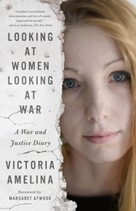
Amelina, Viktorii︠a︡. Looking at Women Looking at War: A War and Justice Diary. First edition., St. Martin’s Press, 2026.
Location: Gohstand Reading Room ; PG3950.1.M45 Z46 2025
Summary
"Destined to be a classic, a poet's powerful look at the courage of resistance When Russia invaded Ukraine on February 24, 2022, Victoria Amelina was busy writing a novel, taking part in the country's literary scene, and parenting her son. Now she became someone new: a war crimes researcher and the chronicler of extraordinary women like herself who joined the resistance. These heroines include Evgenia, a prominent lawyer turned soldier, Oleksandra, who documented tens of thousands of war crimes and won a Nobel Peace Prize in 2022, and Yulia, a librarian who helped uncover the abduction and murder of a children's book author. Everyone in Ukraine knew that Amelina was documenting the war. She photographed the ruins of schools and cultural centers; she recorded the testimonies of survivors and eyewitnesses to atrocities. And she slowly turned back into a storyteller, writing what would become this book. On the evening of June 27th, 2023, Amelina and three international writers stopped for dinner in the embattled Donetsk region. When a Russian cruise missile hit the restaurant, Amelina suffered grievous head injuries, and lost consciousness. She died on July 1st. She was thirty-seven. She left behind an incredible account of the ravages of war and the cost of resistance. Honest, intimate, and wry, this book will be celebrated as a classic"-- Provided by publisher.
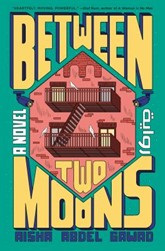
Abdel Gawad, Aisha. Between Two Moons: A Novel. First edition., Doubleday, 2023.
Location: Gohstand Reading Room ; PS3601.B423 B48 2023
Summary
A deeply moving family story about identity, faith, and belonging set in the Muslim immigrant enclave of Bay Ridge, Brooklyn following three siblings coming of age over the course of one Ramadan. It's the holy month of Ramadan, and twin sisters Amira and Lina are about to graduate high school in Bay Ridge, Brooklyn. On the precipice of adulthood, they plan to embark on a summer of teenage revelry, trying on new identities and testing the limits of what they can get away with while still under their parents' roof. But the twins' expectations of a summer of freedom collide with their older brother's return from prison, whose mysterious behavior threatens to undo the delicate family balance. Meanwhile, outside the family's apartment, a storm is brewing in Bay Ridge. A raid on a local business sparks a protest that brings the Arab community together, and a senseless act of violence threatens to tear them apart. Everyone's motives are called into question as an alarming sense of disquiet pervades the neighborhood. With everything spiraling out of control, how will Amira and Lina know who they can trust? A gorgeously written, intimate family story and a polyphonic portrait of life under the specter of Islamophobia, Between Two Moons challenges the reader to interrogate their own assumptions, asking questions of allegiance to faith, family, and community, and what it means to be a young Muslim in America"-- Provided by publisher.
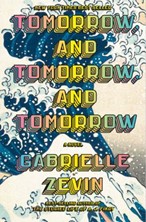
Zevin, Gabrielle. Tomorrow, and Tomorrow, and Tomorrow. First edition., Alfred A. Knopf, 2025.
Location: Gohstand Reading Room ;PS3626.E95 T66 2022
Summary
"A modern love story about two childhood friends, Sam, raised by an actress mother in LA's Koreatown, and Sadie, from the wealthy Jewish enclave of Beverly Hills, who reunite as adults to create video games, finding an intimacy in digital worlds that eludes them in their real lives, from the New York Times best-selling author of The Storied Life of A.J. Fikry"-- Provided by publisher
On a bitter-cold day, in the December of his junior year at Harvard, Sam Masur exits a subway car and sees, amid the hordes of people waiting on the platform, Sadie Green. He calls her name. For a moment, she pretends she hasn't heard him, but then, she turns, and a game begins: a legendary collaboration that will launch them to stardom. These friends, intimates since childhood, borrow money, beg favors, and, before even graduating college, they have created their first blockbuster, Ichigo. Overnight, the world is theirs. Not even twenty-five years old, Sam and Sadie are brilliant, successful, and rich, but these qualities won't protect them from their own creative ambitions or the betrayals of their hearts. Spanning thirty years, from Cambridge, Massachusetts, to Venice Beach, California, and lands in between and far beyond, Gabrielle Zevin's Tomorrow, and Tomorrow, and Tomorrow is a dazzling and intricately imagined novel that examines the multifarious nature of identity, disability, failure, the redemptive possibilities in play, and above all, our need to connect: to be loved and to love. Yes, it is a love story, but it is not one you have read before.
Give to the University Library
Give a Gift Today