Interview with Alex Turney: 2025-26 IGRA Fellow
May 05, 2026
Each year, the library awards the Ronald C. & Elizabeth-ann Purcell International Guitar Research Archives (IGRA) Fellowship to a full-time CSUN student interested in music, library science, music research, and/or the arts who is usually enrolled in the guitar performance program. The 2025-26 IGRA Fellow is CSUN student Alex Tunney. As the fellowship year wraps up, we asked him questions about his interest in music, experiences working as a student assistant in Special Collections & Archives, and exposure to the archival documents and records in the International Guitar Research Archives during his fellowship.
Before we dive into your experiences as this year’s IGRA Fellow, we’d love to learn a bit about you. What are you studying at CSUN, and why did you chose to focus your time here in that area?
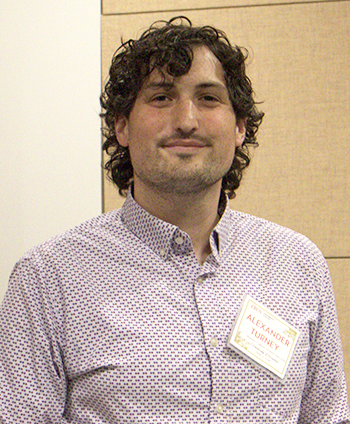 I’m studying guitar performance. During the pandemic, I taught guitar after work and on weekends to socialize and make extra money. My opportunities to perform and teach have grown since then, so I want to build a stronger foundation. Dr. Steve Thachuk’s ability to navigate different genres as a performer and teacher appealed to me, and I felt confident that his versatility would help me build up that foundation.
Why did you decide to apply for the IGRA Fellowship?
Before applying to CSUN, I had been using the IGRA digital archives for sight-reading practice and to find public domain pieces for my students. It was a great way to get outside of the typical repertoire, and my students enjoyed learning music that they hadn’t heard before. When I found out about the fellowship, I was excited to get on board and help expand access to guitar music.
What would you tell other students who are interested in IGRA, but nervous about working with archival collections?
The process can be messy and confusing at times, but you won’t be left alone to figure it out by yourself. When you start working in Special Collections & Archives, you’ll be introduced to all of the places, people, and procedures that you need to know to succeed. If you still end up feeling overwhelmed, the SC&A staff are always willing to help and answer questions.
IGRA Fellows are required to contribute a post to Special Collections & Archives's Peek in the Stacks blog. Last semester, you wrote a post about performance reviews in the Reginald Smith Brindle Collection, and this semester you wrote a post about sheet music from the Oahu Music Company that you found in the Wilma Ferrel Collection. Why did you choose those topics?
I wanted to get to know parts of the IGRA that seemed to get less attention. My research process for the first post about the Brindle Collection was honestly pretty simple: pull a box from a collection that hadn’t been written about in awhile, and then write about it. I wasn’t prepared for that process to work, but it totally did. Diving into the archives without too many expectations made every folder interesting. By the time I left the reading room, I had grown a much deeper appreciation for the composer and the ideas he was trying to work out.
For the second post, I more or less repeated that process. The Ferrel Collection was another IGRA resource that hadn’t gotten much attention from other IGRA fellows. I immediately saw why when I opened the first folder–the music is for a completely different instrument! I ended up doing a lot of background research about ‘steel’ guitar which will hopefully come out in some future projects. For the blog though, I wanted to find something interesting about the collection for non-musicians. While I was looking through one of the folders of music, I noticed that nearly every other page had some kind of ad or pithy statement. When I finally decided to count up all of these ads and aphorisms, I knew I had something interesting for the post.
Did anything about IGRA’s collections surprise or challenge you?
Absolutely. One experience I had processing the Guitar Foundation of America’s collection made me take a step back and appreciate the nuance of archival processing. I noticed that the numbering system for a composer’s works was inconsistent with that composer’s opus numbers, and that some of the opus numbers were incorrect. My supervisor stepped in and reminded me that we were not processing a collection of this composer’s music. Instead, we were processing the GFA’s library. My point may or may not have been correct, but the task at hand was to preserve as much of the GFA’s organization as possible. It felt like defeat at first to move on and use the original system, but I grew to appreciate the broader perspective more and more as we finished the collection. At the end of the experience, I’ve learned that archivists have to create processes and stick to them in order for researchers to be able to do their work. Trying to get ahead of the curve and shape the collection in one way or another might ultimately make that work more difficult.
What do you take away from your experiences working in IGRA and in Special Collections & Archives?
I have two big takeaways from working in IGRA and in Special Collections & Archives. First, I really enjoy diving into archival materials and writing about them. After I graduate from CSUN, research and writing will definitely be a bigger part of my work than I thought it would be before receiving the fellowship. Second, I have way more respect for the hard work archivists do to make materials available. When you request an item as a researcher, it can be easy to take for granted how—and how quickly—that item makes its way into your hands. When you work on the other side, you see how much work goes into making an unprocessed collection available. The level of organization it takes to process new collections while circulating items into and out of storage on a daily basis is astonishing.
Do you have any advice for students who might be interested in applying for the IGRA Fellowship?
My biggest piece of advice would be to stay realistic about what you can accomplish in one year as an IGRA fellow. If you’re anything like me, you’ll want to try to get as much music out there as quickly as possible. There is a reason for every step in the archival process though, and sometimes you just have to slow down and work at the pace of the process. This can make the job tedious and frustrating. Sometimes, you’re engaged in your task and excited about it. Other times, your task is to remove five hundred rusty staples from a pile of documents filled with text that you could not be less interested in. It’s a balance, but ultimately the experience is worth it. You’ll learn a lot, and the staff is flexible and respectful of the fact that your studies come first.
Post tagged as: igra fellowship, igra, archives
Read more Peek in the Stacks blog entries